In the same 430-case test, Jev let through 68–92% of false agent reports and Laya 84–88% when shown evidence; after asking one literal question instead, Jev let through only about 1% of wrong counts and files. The question matters more than the model. Link
𝕏 · Scientific research
0001
AAlejandro Saucedo | KubeCon 2025 AI Day Keynote@AxSaucedo𝕏
A must-read recommendation from Sebastian Raschka, covering the evolution of text classification and introducing Jev, the decision model from TypeSafe AI. Link
This paper examines the accuracy and efficiency of structured decision models such as Jev for hate-speech moderation, offering insights for content moderation. Link
The post asks whether anyone has used Jev-style models as judges in Process Reward Learning (PRL), suggesting that better judges could revive PRL and more supervision leads to better learning.
James Briggs breaks down TypeSafe AI's Jev model and compares it with OpenJev (Von) and tiny GLiNER models, finding that GLiNER with only 74M params performs phenomenally, even beating Jev on Doom.
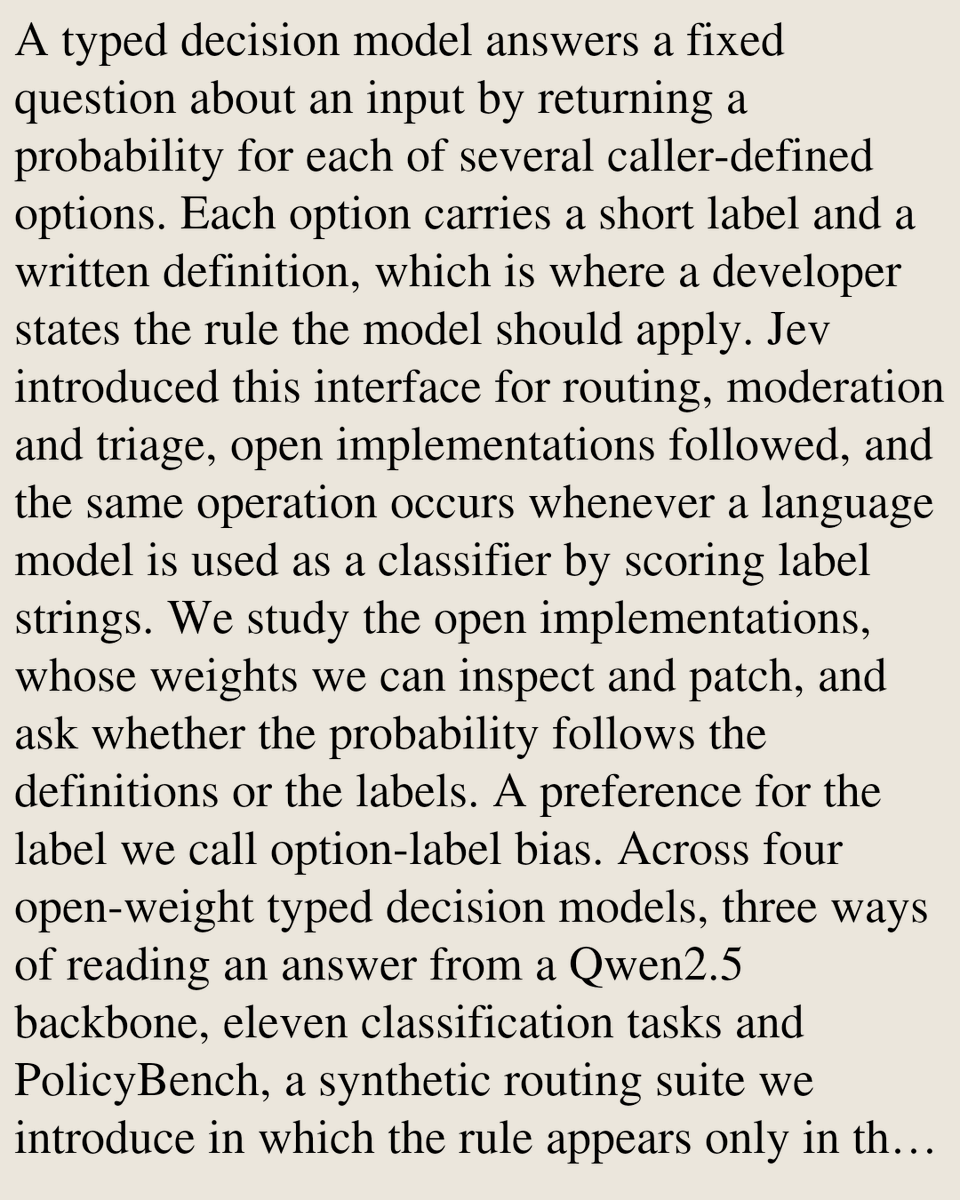
This post shares an arXiv paper "Labels Override Definitions in Jev-Style Typed Decision Models" by Seyedarmin Azizi, Erfan Baghaei Potraghloo, and Massoud Pedram. Link
Researchers evaluated two System-1 decision models—open-weight Laya and hosted Jev—across 11 agent decision points using 7,283 base cases plus 6,640 robustness variants. Jev came out ahead.
This research proposes incorporating the Jev model into Semantic SQL, using LLMs to judge text semantics for SQL filtering and JOIN conditions, addressing the time and cost of per-row evaluation.
Introduces a paper on Chinese-Jev, aiming to extend TypeSafe's System One model to Chinese-language tasks, covering natural language processing and computer vision. Link